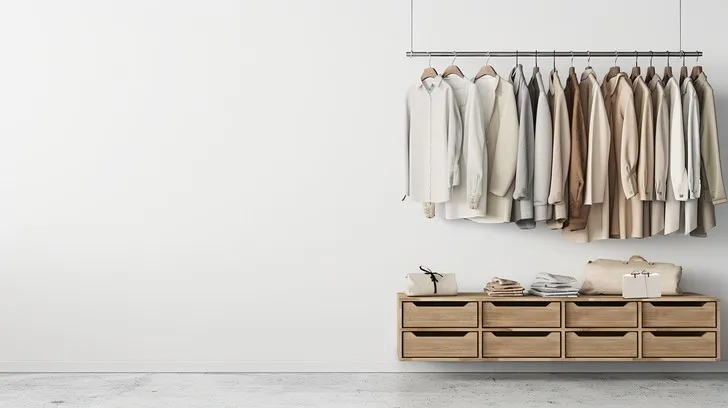
Thirty-Three Items to Enlightenment: Inside the Capsule Wardrobe Rabbit Hole

It starts, as most modern lifestyle obsessions do, with a very clean Instagram grid and the quiet, creeping suspicion that your life is too complicated.
You have too many clothes. You have nothing to wear. These two facts coexist peacefully in your closet every single morning, and one day — probably a Sunday, probably after a frustrating twenty-minute outfit spiral — you type 'simplify wardrobe' into a search bar and the algorithm, ever attentive, ever generous, delivers you unto the capsule wardrobe.
Thirty-three items. Ten weeks. One perfectly curated, endlessly mixable, mathematically harmonious collection of clothing that will, according to the testimonials of approximately four thousand bloggers, change your entire relationship with getting dressed and possibly also with yourself.
Reader, it will not do any of those things. But the journey — the spectacular, spreadsheet-heavy, forum-diving, $180-linen-trouser-purchasing journey — is something to behold.
The Promise: A Life of Serene Morning Decisions
The pitch of the capsule wardrobe is, admittedly, extremely compelling. You will own fewer things. Those things will be better. Everything will go with everything else because you will have selected your pieces according to a cohesive color palette, typically described as a 'neutral foundation with one or two accent tones,' which sounds like interior design advice but is apparently also how you're supposed to organize your pants.
You will no longer stand in front of a full closet feeling nothing. You will stand in front of a curated, breathable, artfully minimal closet feeling calm. The decision fatigue that has been quietly destroying your mornings will evaporate. You will get dressed in seven minutes. You will look put-together in a way that appears effortless because it is, in fact, effortless — the effort having been front-loaded into a single rigorous curation process that you will complete once and never have to repeat.
This is the promise. Let's talk about what actually happens.
Week One: The Audit (A Horror Film)
Every capsule wardrobe journey begins with The Closet Audit, which is described in the literature as a 'liberating inventory process' and is actually a four-hour confrontation with every impulse purchase, abandoned aesthetic, and aspirational size you've accumulated over the past decade.
You are instructed to remove everything. You place it on your bed. You look at it. The pile is larger than you thought possible given the square footage of your closet. There are items in here you forgot you owned. There is a phase you went through in 2021 that you would prefer not to revisit. There is a blazer that still has the tags on it from a sale three years ago that you bought because it was 'such a good deal' and have worn exactly never.
The audit asks you to assess each item against three criteria: Does it fit? Do you love it? Does it align with your 'style vision'? The third criterion requires you to have a style vision, which you do not yet have, which is why you are doing this. You set the blazer aside in the 'maybe' pile, which grows to approximately the same size as the original pile, and you take a break to look at capsule wardrobe content online for forty-five minutes, which is not helping.
The Spreadsheet Era: When Simplicity Gets Complicated
At some point in the capsule wardrobe process — usually around week two, when you have successfully donated three bags of clothing and are now staring at a closet that feels sparse but not curated — you discover the forums.
There are entire communities dedicated to the science of capsule wardrobes. They have terminology. 'Cost per wear' calculations. Heated debates about whether a white shirt and a cream shirt can coexist in the same 33-item collection (consensus: it depends on your undertones, which you now need to determine). There are color palette generators. There are people who have rebuilt their wardrobes three times in pursuit of the mathematically perfect neutral foundation.
You make a spreadsheet. The spreadsheet has columns for item type, color, fabric, cost, cost-per-wear projection, and a column labeled 'versatility score' that you invented yourself and cannot fully explain. The spreadsheet is, objectively, more complicated than your tax return. You spend a Saturday afternoon on it. You feel productive. You have not gotten dressed any faster.
This is the capsule wardrobe's central irony, and it is a profound one: the pursuit of radical simplicity is, procedurally, one of the most labor-intensive things you can do with your leisure time. The people who look effortlessly minimal got there through maximum effort. Every 'I just own ten things' person has a spreadsheet. Every 'I never think about what to wear' person has spent more time thinking about what to wear than someone who just... buys clothes sometimes without a system.
The 'Last Jacket You'll Ever Need' Problem
The capsule wardrobe canon is littered with promises of finality. The last white shirt you'll ever buy. The only pair of trousers you'll need. The jacket that ends all jacket searches.
These items have a lifespan of approximately one season.
Not because they wear out — they are, by definition, high quality, because you invested in quality instead of quantity, because that's the whole point — but because the capsule wardrobe is a living document, and living documents require updating, and updating requires research, and research surfaces new contenders, and new contenders reveal gaps in your current collection that you hadn't previously identified, and suddenly the perfect navy blazer you bought in October has been superseded by a slightly different navy blazer that sits better on the shoulder and is, crucially, more of a 'true navy' versus the 'slightly purple navy' of the previous blazer, a distinction you could not have articulated six months ago but now cannot un-see.
The capsule wardrobe does not end the shopping. It redirects it. Instead of impulse purchases, you make considered, researched, philosophically justified purchases that cost significantly more and require a revision of the spreadsheet.
The Actual Outcome (Which Is Fine, Really)
Here's the thing about the capsule wardrobe that the content ecosystem won't tell you because it doesn't make good content: for most people, it sort of works, partially, in a way that doesn't quite match the brochure but is genuinely an improvement over the before-times.
You do own better things. You do think more carefully before buying. You do, on most mornings, get dressed slightly faster because you've eliminated the truly unwearable options and at least given yourself a coherent starting point. The spreadsheet was excessive, but the underlying principle — own things you actually like and wear — is so obvious it barely needed a movement, and yet here we are, because apparently we all needed someone to put it in an aesthetically minimal font on a blog to take it seriously.
The capsule wardrobe is not a personality. It is not a spiritual practice. It is not the answer to whatever ambient dissatisfaction drove you to the audit in the first place.
But the linen trousers are genuinely great. Worth every penny of the $180. Versatility score: nine out of ten.
The spreadsheet said so.