Transitional Phase Forever: Why 'I'm Still Figuring It Out' Is Actually America's Most Honest Style Identity

Photo: KPNO/NOIRLab/NSF/AURA/P. Horálek (Institute of Physics in Opava), CC BY 4.0, via Wikimedia Commons
Transitional Phase Forever: Why 'I'm Still Figuring It Out' Is Actually America's Most Honest Style Identity
The transitional phase has a specific smell. It smells like a closet that contains, without irony or resolution, a floral prairie dress, a structured black blazer, a graphic tee from a band you saw once in 2018, and a pair of cargo pants you bought because the internet was extremely convincing about them for approximately six weeks.
These items do not speak to each other. They do not share a color story. They represent at least three different people you were considering becoming, none of whom have been formally retired. They are all, technically, you — just different chapters, different moods, different Tuesday-morning versions of a person who is, as you will explain to anyone who notices the chaos, in a transitional phase.
The transitional phase is fashion's most durable legal defense. And we're here to argue it might also be the most honest outfit philosophy in America.
The Anatomy of the Transitional Closet
Every transitional closet tells a story. Specifically, it tells about six stories simultaneously, none of which have a satisfying conclusion.
There is the Aspirational Section — the pieces you bought for the person you were planning to become. The structured blazers. The silk blouses. The trousers with a proper crease. These items were purchased during a period of high self-belief, possibly following a career milestone or a very motivating Sunday afternoon. They hang in a state of dignified waiting, still tagged in some cases, quietly confident their time will come.
There is the Archaeological Layer — the pieces that survived multiple closet purges through a combination of sentimentality and low-grade superstition. You haven't worn the floral midi skirt in two years, but getting rid of it feels like closing a door on something. You're not sure what. You keep it.
There is the Recent Acquisition Zone — the new stuff, purchased during a moment of stylistic clarity that felt like a complete identity revelation at the time. These items represent Current You, the most evolved version, the person who has finally figured out what they're doing. In eighteen months, they will migrate to the Archaeological Layer.
And then there is the Unexplained Item — the single piece that doesn't fit any narrative. You don't remember buying it. You don't know who it was for. It stays because removing it would require confronting it, and you are not ready for that conversation.
The Phases: A Brief Oral History
If you've been a fashion-aware American at any point between 2015 and right now, you have lived through at least several of the following aesthetic phases, each of which left survivors in your closet.
The Minimalist Era (Approx. 2016–2019): You were going to own thirty items. Quality over quantity. A capsule wardrobe. You bought a $90 white tee and a single pair of perfect black trousers. You also kept everything else. The minimalist era left behind: two crisp button-downs, a very good tote bag, and a faint sense of moral superiority that occasionally resurfaces.
The Cottagecore Detour (2020–2021): A pandemic-era pivot toward prairie dresses, linen everything, and the sincere belief that you would be happier if you owned a small farm. You do not own a small farm. You own three floral dresses and a basket-weave bag that has not seen sunlight since September 2021.
The 'Corporate Chic Reclamation' Phase (Ongoing, Intermittent): Triggered by a new job, a promotion, or watching too many 'boss aesthetic' TikToks in a single evening. Resulted in: blazers, loafers, possibly a structured handbag. Some of these items are doing great. Others are witnesses to a vision that never fully materialized.
The Quiet Luxury Spiral (2023–Present): You saw a lot of beige on the internet and felt something. You bought some beige. You are working on the rest.
The Defense Rests: Why 'Transitional' Is a Valid Plea
Here is the thing about the transitional phase that nobody wants to say out loud: for a lot of people, it never really ends. And that's not a failure of self-knowledge or discipline. That's just what it looks like when a real human being with a real, evolving life tries to dress themselves across time.
Personal style, as it's sold to us — cohesive, intentional, recognizable, instantly Instagrammable — is largely a fiction. Or rather, it's a snapshot. The 'I have a signature style' people are either extremely consistent humans (they exist, they are rare, they are probably Virgos) or they have simply landed on a current chapter and haven't announced the next one yet.
Most of us are somewhere in the middle: we know some things we like, we're suspicious of other things we used to like, and we're genuinely curious about a few things we haven't tried yet. That is not a transitional phase. That is a relationship with clothing — ongoing, complicated, occasionally frustrating, and honestly kind of interesting.
The Honest Outfit Philosophy
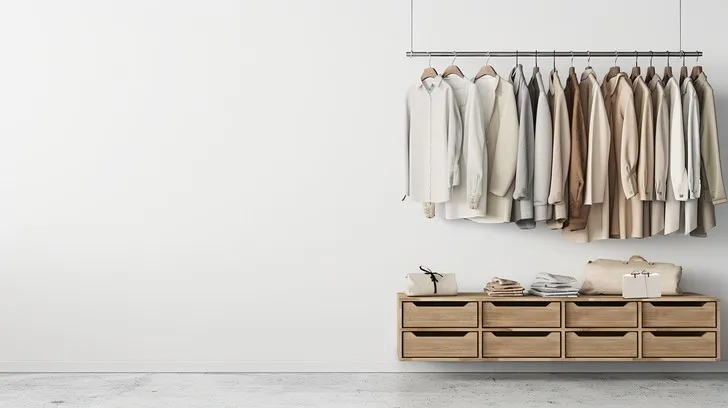
The transitional phase closet, for all its apparent chaos, contains a kind of integrity that the perfectly curated aesthetic wardrobe sometimes lacks. It is a document. It shows where you've been and where you're headed and the weird, wonderful in-between space where most actual living happens.
The person who can look at their closet — three aesthetics, no coherent color story, one item from a personality they briefly tried on in 2019 — and say 'I'm figuring it out' is telling the truth in a way that fashion culture rarely rewards but absolutely should.
So keep the prairie dress. Keep the blazer. Keep the cargo pants and the silk blouse and the Archaeological Layer item you can't explain. Your closet is not a mess. It's a memoir.
You're not in a transitional phase. You're just being honest about the whole thing.
And honestly? That's a look.