The Capsule Wardrobe Industrial Complex: How 'Buying Less' Became a Six-Week Research Project
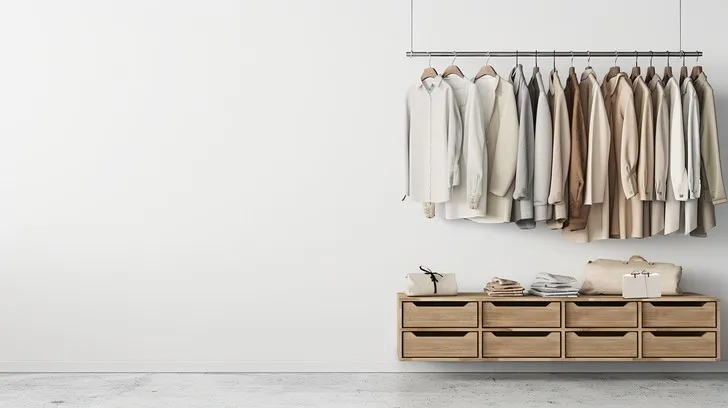
Photo: organized minimalist closet wardrobe neutral color clothes, via images.stockcake.com
The Capsule Wardrobe Industrial Complex: How 'Buying Less' Became a Six-Week Research Project
The capsule wardrobe was born from a genuinely reasonable idea. In 1970, a boutique owner named Susie Faux suggested that a small collection of versatile, high-quality pieces could serve as the foundation of an effortless wardrobe. Simple. Elegant. Achievable.
 Photo: Susie Faux, via bukvybag.com
Fifty years later, that idea has been processed through the content machine and emerged as a seventeen-part YouTube series, a $49 color analysis consultation, a Pinterest board with 847 pins, and a spreadsheet so complicated it has its own legend.
Congratulations. You set out to own fewer things, and you have created a full-time job.
The Promise vs. The Reality
The capsule wardrobe pitch is irresistible, especially to a certain kind of person — the person who is exhausted by their closet but not exhausted enough to simply throw things away and stop buying more. The promise goes like this: curate a small, intentional collection of timeless pieces that all work together, and you will never again stand in front of your closet feeling like you have nothing to wear.
This promise is delivered with the calm authority of someone who has clearly never experienced a Monday morning in their life.
The reality is that the capsule wardrobe system doesn't eliminate decision fatigue — it just relocates it. Instead of standing in front of your closet for twenty minutes, you now spend six weeks researching what should be in your closet. You watch videos. You read blog posts. You take a quiz that tells you your "style personality" is "Classic with Romantic undertones," and you stare at that result for longer than you should.
The Content Creator Industrial Complex
The capsule wardrobe content economy is a marvel of self-perpetuating media. Every creator in the space has a slightly different number for how many pieces constitute a capsule — you'll see 33, 37, 40, 50, and occasionally someone wild who says 25 and means it. Every creator also has a slightly different list of what those pieces should be, ensuring that no two capsule wardrobes are actually the same, which somewhat undermines the whole concept of a universal, simplified system.
But the real genius of the capsule wardrobe content machine is the seasonal refresh. Because a capsule wardrobe isn't just a capsule wardrobe — it's a spring capsule wardrobe, a fall capsule wardrobe, a transitional weather capsule wardrobe, and, for the truly committed, a travel capsule wardrobe that somehow requires 31 pieces for a four-day trip.
Each season brings new videos, new PDFs, new "essentials" lists. The machine never stops producing content about buying less. This is not a paradox the machine acknowledges.
The 37 Essential Pieces That Will Not Save You
Let's examine the typical capsule wardrobe list for a moment. You will find, reliably, the following: a white button-down shirt, a well-fitted blazer, dark wash jeans, a little black dress, a trench coat, a cashmere sweater, white sneakers, loafers, and something described as a "classic tote."
These items are described as "timeless" and "versatile" and "investment pieces" — a phrase that does a lot of heavy lifting in this space. An investment piece is simply an expensive item that costs enough to require justification. The justification is always that you will wear it forever, which is statistically unlikely given that you've already replaced your "forever" white button-down four times.
The capsule wardrobe list also assumes that your life is lived in a specific, aspirational way. It assumes you attend gallery openings, work in an office with a vague-but-sophisticated dress code, occasionally take weekend trips to somewhere with cobblestones, and never do anything that might result in a stain. It does not account for the actual texture of American life, which involves a lot of takeout, pet hair, and occasions where you genuinely cannot tell if something is business casual or not.
The Color Palette Rabbit Hole
If the piece count is the entry point, the color palette is where people truly lose themselves. The capsule wardrobe system insists that your pieces must all work together, which means they must share a coherent color story. Finding your color story requires, apparently, an entire separate research project.
There are seasonal color analysis consultants who will tell you whether you are a Spring, Summer, Autumn, or Winter — a system originally developed in the 1980s that has experienced a full TikTok renaissance. There are digital color palette tools. There are "capsule wardrobe color wheel" diagrams that look like something you'd find in a graphic design textbook. There are people who have spent more time thinking about whether they are a "warm neutral" or a "cool neutral" than they have thinking about their retirement savings.
The color palette system is seductive because it feels scientific. It promises that if you get the palette right, the outfits will simply generate themselves. In practice, discovering your palette leads to the realization that approximately 60% of your current wardrobe is the wrong color, which means you need to replace it, which means the capsule wardrobe has now cost you more money than your previous habit of buying things impulsively at Target.
The Spiritual Dimension
What makes the capsule wardrobe movement genuinely fascinating — and genuinely funny — is the quasi-spiritual language that surrounds it. Practitioners talk about "intentional living" and "conscious consumption" and "aligning your wardrobe with your values." Getting dressed is no longer a logistical task; it's a practice. Your closet is not storage space; it is a reflection of your inner life.
This framing is effective because it makes the whole project feel meaningful. You are not just buying fewer clothes. You are becoming a more authentic version of yourself. You are reducing noise. You are living deliberately.
You are also, at this exact moment, watching your seventh YouTube video about the perfect white t-shirt.
The Way Out
The honest version of capsule wardrobe advice is this: wear what you actually wear, get rid of what you don't, and stop buying things that don't fit your actual life. This advice is free, takes about forty-five minutes, and generates zero content.
Which is perhaps why nobody is making YouTube videos about it.