The Zoom Mullet Is Real, and It Might Be the Most Honest Outfit in America
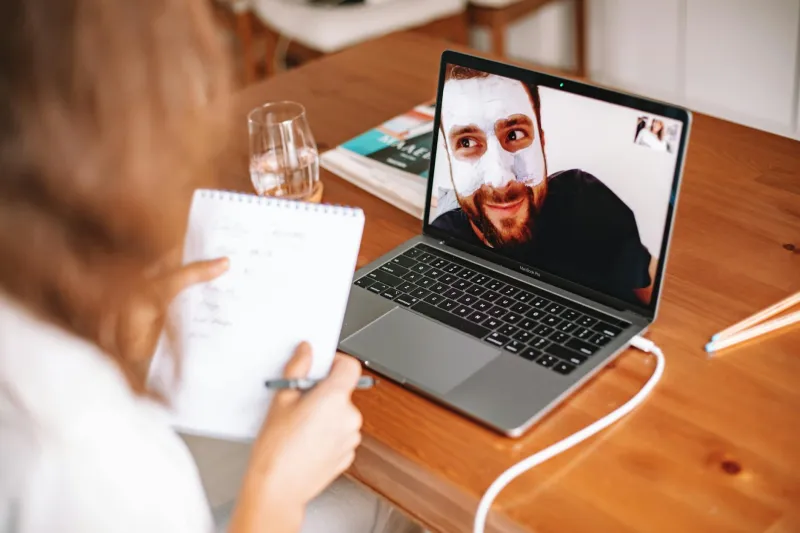
The Zoom Mullet Is Real, and It Might Be the Most Honest Outfit in America
Let's establish the scene. It is 9:54am on a Tuesday. You have a team call at 10. You are wearing a structured blazer in a respectable neutral, a clean crewneck, or possibly a crisp button-down — something that communicates I am a professional and I have my life together. Your hair is done. Your background is either tastefully blurred or strategically staged with a plant and a bookshelf.
From the waist down, you are wearing pajama pants with small dogs on them. Or athletic shorts. Or, and this is not a judgment, nothing in particular at all.
This is the Zoom Mullet. Business on top, complete personal sovereignty on the bottom. And after five-plus years of remote and hybrid work reshaping how Americans live, dress, and perform professionalism, we are prepared to make the case that it is not a failure of standards — it is actually the most structurally honest outfit this country has produced in a very long time.
How We Got Here
Cast your mind back to early 2020, when the entire American workforce was abruptly relocated to kitchen tables and spare bedrooms and had to figure out, in real time, what 'professional' meant when nobody could see your pants.
The initial instinct was to maintain normalcy. People were getting fully dressed for video calls. There were LinkedIn posts about the importance of wearing real shoes while working from home, for the discipline of it. Blazers were being worn over t-shirts at 8am in apartments where the coffee hadn't even finished brewing yet.
This phase lasted approximately two weeks.
After that, the great fracture happened. The top half stayed professional because it had to — the camera was watching. The bottom half was liberated because nobody could see it, and honestly, the sweatpants were right there, and the world was a lot, and who among us was going to put on dress pants in their own home.
The Zoom Mullet was not a choice so much as a natural evolutionary response to the environment.
The Quiet Industry That Built Up Around Your Top Half
Here is something that does not get talked about enough: an entire micro-economy emerged to serve the camera-ready upper body.
The 'elevated loungewear' category exploded. Brands started marketing blazers specifically as 'WFH-friendly' — structured enough to read as professional on camera, comfortable enough to wear while sitting on a couch for eight hours. The 'professional hoodie' became a real product category. Direct-to-consumer menswear brands pivoted to selling what amounted to comfortable shirts that photographed well.
Neck-up grooming products had a moment. Ring lights, originally the domain of beauty influencers and YouTubers, became a standard home office accessory for people who just wanted to look alive on their 10am standup. The camera angle became a genuine styling consideration — not in a vain way, but in the way that any performer thinks about lighting and framing.
Meanwhile, the loungewear industry — already growing — absolutely detonated. Cozy sets, elevated sweatpants, the whole soft dressing movement: much of this was downstream of a culture that had decided the lower half of the body deserved comfort while the upper half remained on duty.
What WFH Dressing Actually Says About Us
Traditional office dressing is, when you strip it down, a performance of effort. The suit, the blouse, the polished shoes — these things signal that you have prepared, that you take the setting seriously, that you respect the social contract of the workplace. They are costumes, in the best sense of the word.
What the Zoom Mullet revealed is that a significant portion of that performance was always about being seen, not about functioning. When nobody could see your pants, the pants stopped mattering. And the sky did not fall. Productivity did not collapse. The work got done.
This is, if you think about it, a genuinely interesting piece of data about what professional dress codes are actually for.
The blazer over pajamas is not laziness. It is the most logical possible response to a situation where only the visible portion of your body needs to communicate anything. You are not deceiving anyone — your colleagues know what's happening below the frame. Everyone is in on the bit. The Zoom Mullet is a collective social agreement, and there is something almost refreshing about that.
The Hybrid Era Complicates Things
Of course, the return-to-office — even the partial, grudging, three-days-a-week version — introduced a new set of complications.
The WFH wardrobe and the office wardrobe have diverged so significantly for many people that going back into a physical workplace now requires a kind of re-translation. Things that felt natural on camera look different in person. The elevated loungewear set that photographed beautifully in a home office does not necessarily play the same way in a conference room in Midtown.
And then there is the psychological adjustment. After years of only needing to dress the top half, full-body professional dressing feels almost theatrical. Why are these pants happening? Who decided on shoes? The whole thing requires a recalibration that, for many people, has been quietly stressful in ways they can't quite articulate.
The fashion industry has tried to bridge this gap with 'smart casual' and 'elevated basics' and a thousand variations on the comfortable-but-professional pitch. Some of it works. But the fundamental tension remains: we have tasted the freedom of the pajama bottom, and we cannot un-taste it.
In Defense of the Mullet
Here is the thing about the Zoom Mullet that nobody wants to say out loud: it is actually great. Not as an aesthetic, necessarily, but as a philosophy.
Getting dressed has always involved some degree of performance — dressing for the context you're in, the people you're with, the impression you want to make. The WFH era just made the backstage visible. It revealed that we were always only dressing for the parts of ourselves that were on display, and it gave us permission to stop pretending otherwise.
The blazer-and-pajama-pants combination is not a sign of civilizational decline. It is a sign of a culture that got honest, briefly, about the relationship between clothing and audience. We dress for the camera. We dress for the room. When there is no room and no camera, we dress for ourselves — and apparently, for ourselves, we choose soft pants and we are not sorry about it.
The Zoom Mullet is the most American outfit imaginable: practical on the outside, doing whatever it wants on the inside, and completely uninterested in your opinion about it.