The Hydration Nation Declaration
There's a specific type of woman roaming American suburbs right now, and you'll know her when you see her. She's got a 40-ounce Stanley tumbler in one hand, a phone documenting her "water intake journey" in the other, and an entire personality built around the revolutionary concept of... drinking water.
Welcome to 2024, where hydration isn't just about survival—it's about aesthetics, identity, and somehow making the most basic human need into a full-time lifestyle brand.
From Utility to Identity
Let's rewind for a second. The Stanley brand has been around since 1913, originally making thermoses for blue-collar workers who needed their coffee to stay hot during long shifts. Fast-forward to today, and that same industrial-strength technology is being used to ensure that Jessica from accounting's lemon water stays perfectly chilled while she takes seventeen Instagram stories about her "hydration goals."
How did we get here? How did a water bottle become a personality trait?
The answer lies in the perfect storm of influencer culture, wellness trends, and our collective need to turn literally everything into a curated aesthetic experience. Because apparently, drinking water from a regular cup like some kind of peasant is no longer acceptable in polite society.
The Great Stanley Stampede
Remember when people used to camp out for concert tickets or Black Friday deals? Now they're lining up at Target at 6 AM for the latest Stanley color drop. We've witnessed grown adults sprinting through store aisles, fighting over limited-edition tumblers like they're the last iPhone on Earth.
The secondary market is even more unhinged. Limited-edition Stanleys are selling for hundreds of dollars on resale sites. People are literally flipping water bottles for profit. What a time to be alive.
And don't even get us started on the Valentine's Day Target collaboration that broke the internet. Nothing says romance like a pink tumbler that keeps your beverage at the optimal temperature for eight hours.
The Color-Coded Life
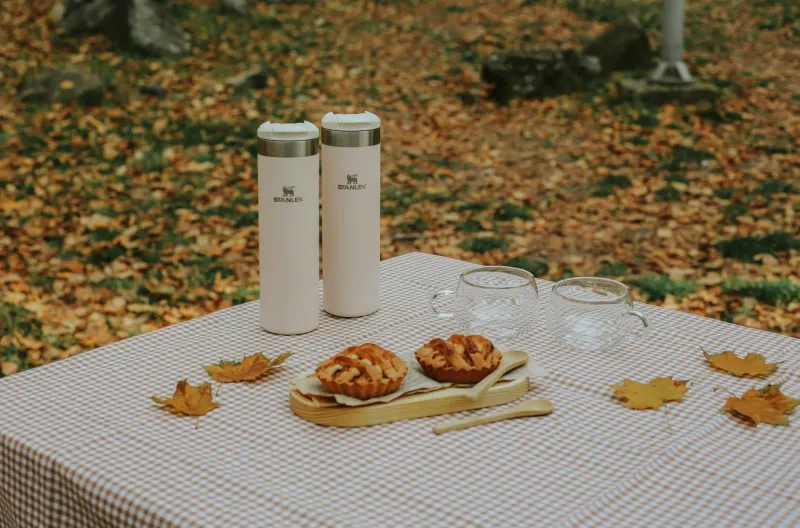
But here's where it gets really interesting: Stanley ownership isn't just about hydration anymore. It's about having the right Stanley for the right occasion. The pink one for spring vibes. The sage green for wellness Wednesday. The cream for when you're feeling minimalist but still want everyone to know you spent $45 on a cup.
We've entered an era where people are coordinating their water bottles with their outfits, their car interiors, and their seasonal mood boards. There are entire TikTok accounts dedicated to Stanley styling tips. STYLING TIPS. For a water bottle.
The Accessory Ecosystem
Of course, owning a Stanley is just the beginning. There's now an entire cottage industry built around Stanley accessories. Handle covers, bottom protectors, carrying cases, name tags, decorative charms—because apparently, your $50 water bottle isn't complete without another $30 worth of add-ons.
People are bedazzling their Stanleys. They're getting them engraved. They're buying multiple handles in different colors to match different outfits. We've somehow turned hydration into a customizable lifestyle experience that requires ongoing financial investment.
The Social Media Hydration Performance
Perhaps the most fascinating aspect of Stanley culture is how it's transformed drinking water into a social media performance. "Getting my water in" has become a content category. People are documenting their daily water intake like they're training for the Olympics.
There are morning routine videos featuring Stanley fill-ups. Afternoon "hydration check-ins." Evening roundups of how many refills they managed. We're literally watching people drink water and calling it entertainment.
And let's talk about the Stanley "water recipes"—because apparently, adding lemon slices and mint leaves to water is now considered advanced mixology worthy of a tutorial.
The Wellness Industrial Complex
The Stanley phenomenon is really just the latest manifestation of our obsession with turning basic self-care into a purchasable identity. We've taken drinking water—something humans have done successfully for thousands of years without specialized equipment—and convinced ourselves we need a $50 tumbler to do it properly.
It's wellness culture meets consumer culture meets social media culture, all wrapped up in a stainless steel package with a convenient handle.
The messaging is clear: if you're serious about your health, if you're really committed to self-care, if you want to be the kind of person who has their life together, you need the right water bottle. Preferably one that photographs well and matches your aesthetic.
The Practical Reality Check
Here's the thing nobody wants to admit: most of these Stanleys are sitting in cars, collecting dust, or being forgotten on kitchen counters across America. Because as it turns out, carrying around a 40-ounce tumbler everywhere you go is actually pretty inconvenient.
They don't fit in cup holders. They're heavy when full. They make that distinctive Stanley sound every time you set them down, announcing your hydration status to everyone within a ten-foot radius.
But practicality isn't really the point, is it? The point is the identity. The point is being the kind of person who owns a Stanley, who prioritizes hydration, who has their wellness game figured out.
The Cultural Mirror
What's really fascinating about the Stanley phenomenon is what it reveals about our current cultural moment. We're living in an age where even the most mundane activities need to be optimized, aestheticized, and turned into content.
Drinking water isn't enough—it has to be intentional hydration with the right equipment, documented for social media, and coordinated with your personal brand. We've somehow convinced ourselves that the vessel matters as much as the action.
The Inevitable Backlash
Of course, we're already seeing the Stanley backlash. The "I'm not like other girls, I drink from a regular water bottle" crowd is emerging. The minimalists are horrified by the accessory ecosystem. The environmentalists are questioning whether we really needed another single-use product trend.
But here's the plot twist: the people criticizing Stanley culture are probably doing it while sipping from their own carefully chosen water vessel—whether it's a Hydro Flask, a Yeti, or that one glass bottle from Whole Foods that makes them feel morally superior.
The Real Tea (Or Water)
At the end of the day, maybe the Stanley phenomenon isn't really about water bottles at all. Maybe it's about finding small ways to feel special, to express personality, to participate in a shared cultural moment in an increasingly fragmented world.
If spending $45 on a tumbler makes someone feel more motivated to stay hydrated, more connected to a community, more confident in their daily routine—is that really so terrible? In a world full of actual problems, perhaps we can allow people to find joy in their color-coordinated hydration systems.
Just don't expect the rest of us to pretend it's not a little bit ridiculous. Because at the end of the day, it's still just water in a cup—no matter how many Instagram stories it inspires.