The Scene of the Crime
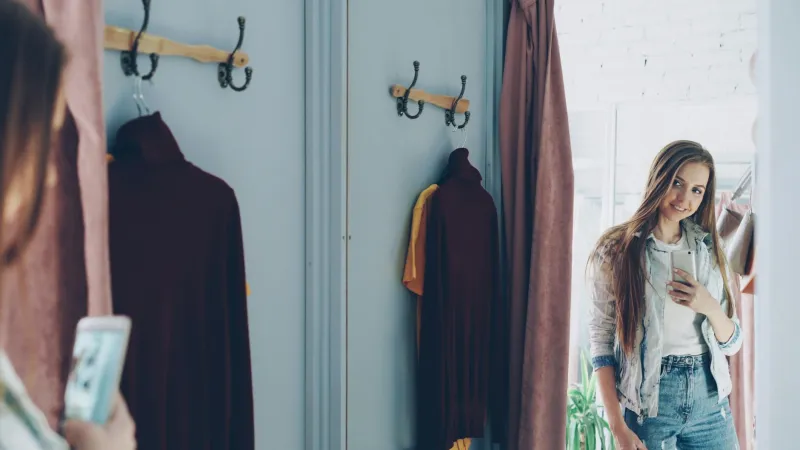
Let's set the scene: You're standing in a 4x4 dressing room that smells like a combination of other people's perfume and retail desperation. The lighting is doing things to your complexion that violate the Geneva Convention. You're wearing a dress that looked cute on the hanger but now makes you question every life choice that led you to this moment.
 Photo: Geneva Convention, via www.deutschland.de
Naturally, you pull out your phone.
Because nothing says "authentic shopping experience" like spending twenty minutes choreographing a photo that's supposed to look spontaneous.
The Great Dressing Room Selfie Conspiracy
Here's what we need to acknowledge: the dressing room selfie is performance art masquerading as documentation. It's not about showing your friends what you're trying on—it's about creating a carefully curated moment of "effortless" authenticity that requires more effort than a Broadway production.
Every dressing room selfie follows the same unspoken protocol. There's the initial "Oh, I'll just take a quick pic" moment, followed by what can only be described as an elaborate photo shoot conducted in a space smaller than most people's closets.
The Angle Olympics
First comes the angle investigation. This isn't just taking a photo—this is advanced geometry. You're working with mirrors, fluorescent lighting, and the fundamental challenge of making a dressing room look like anywhere other than a dressing room.
There's the high angle (classic, slimming, makes everyone look like they have longer legs and better life choices). The straight-on approach (risky, honest, usually abandoned immediately). The slight side angle (mysterious, suggests cheekbones, implies you might be the kind of person who knows things about lighting).
You try holding the phone up high, then low, then at exact eye level. You discover muscles in your arm you didn't know existed. You become intimately familiar with every ceiling tile in your temporary retail prison.
The Lighting Negotiation
Dressing room lighting is designed by people who clearly have never seen a human face they didn't want to destroy. It's the visual equivalent of being interrogated by someone who's really disappointed in your life choices.
But you're determined to make this work. You angle toward the one corner where the light is slightly less offensive. You experiment with the flash (too harsh, makes you look like a deer in headlights who's also having an identity crisis). You try the front-facing camera, then the back camera, then question why phone cameras even exist.
Some brave souls attempt to use the dressing room mirror as a lighting reflector, creating photos that look like they were taken during a solar eclipse.
The Pose Laboratory
Now comes the real artistry: finding a pose that suggests you definitely didn't spend fifteen minutes figuring out how to position your body.
There's the "I'm just casually looking at myself" pose (hand on hip, slight smile, eyes focused somewhere off-camera like you're contemplating something profound about fashion).
The "candid adjustment" pose (caught in the act of smoothing the fabric, very natural, very "I definitely wasn't posing").
The "mirror selfie but make it artistic" approach (phone partially obscuring face, because mystery is everything).
And the classic "I'm asking for your opinion" pose (direct eye contact with camera, slight questioning expression, even though you've already decided whether you're buying this thing).
The Seventeen-Shot Reality
Here's what the final Instagram story doesn't show: the sixteen photos you deleted immediately. The ones where you look like you're being held hostage by retail. The ones where the angle makes you appear to have no neck, or conversely, only neck. The ones where you accidentally captured your own confusion and existential dread.
There's always at least one photo where you somehow look like a completely different person—not in a good way, but in a "who is this stranger and why are they wearing my clothes" way.
The photo that makes it to social media is the survivor of a brutal elimination process that would make reality TV producers proud.
The Caption Choreography
The visual component is just half the performance. The caption requires its own level of strategic thinking.
"Trying this on...thoughts?" (Translation: I've already decided I'm buying this but need validation)
"Not sure about this one" (Translation: I love it but don't want to seem too eager)
"Quick Target run turned into...this" (Translation: I've been here for two hours and this is my fourth store)
"Does this work?" (Translation: Tell me I look amazing or I'm having a breakdown in aisle seven)
The goal is to sound casual while secretly fishing for specific compliments that will justify whatever financial decision you're about to make.
The Response Analysis
Once posted, the dressing room selfie enters its final phase: response analysis. You're not just looking for likes—you're conducting market research.
The fire emoji means buy it immediately. The heart-eyes emoji suggests strong approval. A simple "cute!" is positive but not overwhelming. No response from your most fashionable friend is basically a veto.
You screenshot the responses to study later, like you're analyzing polling data for a political campaign where the only thing at stake is whether you spend $47 on a dress you'll probably wear twice.
The Reality Gap
Here's the cruel irony: by the time you get home, that perfectly curated dressing room selfie bears no resemblance to how the garment actually looks on you in normal lighting, in your normal life, without the adrenaline of retail decision-making.
The dress that looked effortlessly chic in the dressing room selfie somehow becomes "business casual scarecrow" in your bedroom mirror. The lighting that you negotiated with for twenty minutes was apparently a liar and a fraud.
This is when you realize that the dressing room selfie wasn't documenting reality—it was creating a parallel universe where you're the kind of person who looks good in fluorescent lighting and makes confident fashion choices.
The Cultural Significance
The dressing room selfie represents something larger than just shopping documentation. It's about our relationship with authenticity in the age of social media. We want to share genuine moments, but we also want those moments to look good on camera.
It's the intersection of "being real" and "looking good," and spoiler alert: those two things don't always align, especially under retail lighting that was designed by people who clearly have beef with human faces.
The Honest Truth
Maybe it's time to admit what we all know: the dressing room selfie is elaborate theater. And that's okay. We're all participating in the same performance, all pretending that our "quick try-on pics" are spontaneous while secretly knowing they required more planning than most people's vacation photos.
The real question isn't whether dressing room selfies are authentic—it's whether we can enjoy the performance without losing ourselves in it. Because at the end of the day, the best outfit is the one that makes you feel good when you're not trying to photograph it.
Though let's be honest—we'll probably still take seventeen shots just to be sure.